
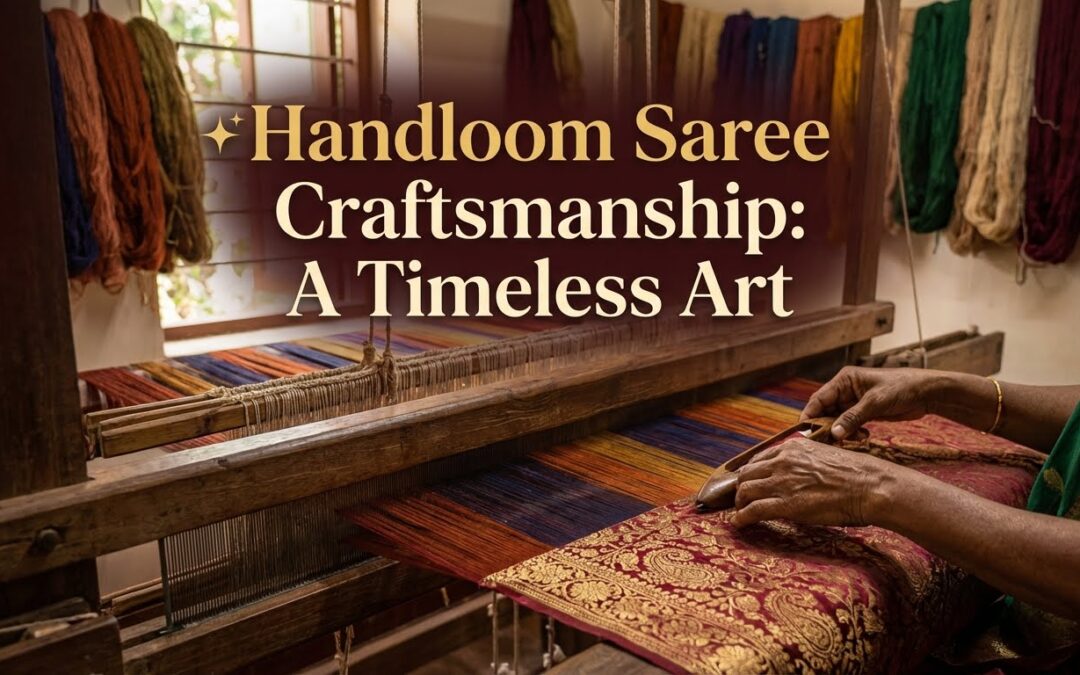
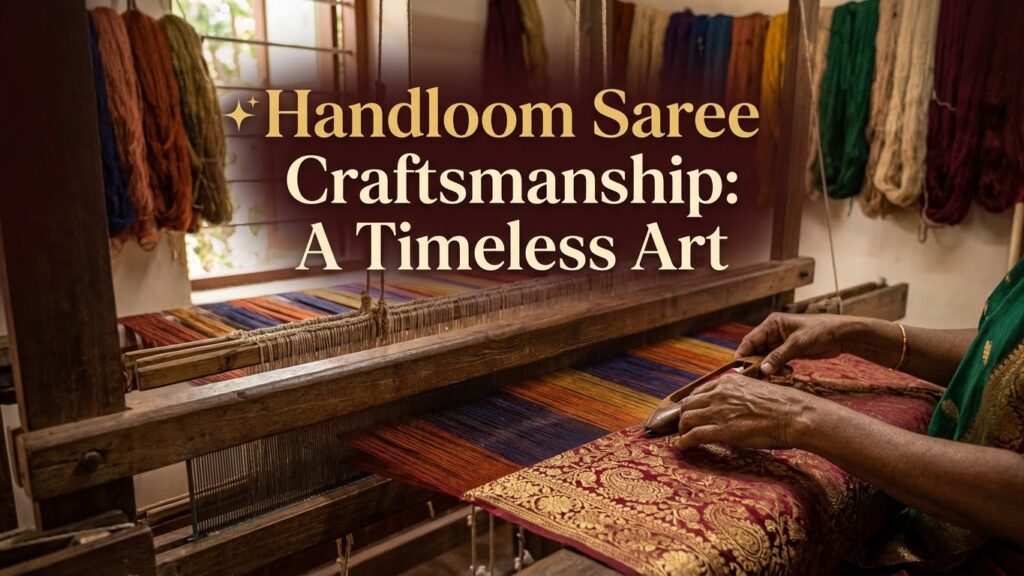
Handloom saree craftsmanship is the ancient art of weaving sarees by hand using traditional looms, where skilled artisans spend days or weeks creating each piece. Every handloom saree tells a story through its unique patterns, colors, and weaving techniques passed down through generations. Loom weaving techniques involve interlacing threads manually to create intricate designs, making each saree one-of-a-kind. These sarees are not just clothing—they represent cultural heritage, artistic expression, and the dedication of countless weavers who keep this craft alive.
Contents
- 1 Introduction: Why Every Handloom Saree Has a Soul
- 2 What Is a Loom?
- 3 The Basic Process of Loom Weaving Techniques
- 4 Challenges Faced by Weavers
- 4.1 The Joy They Find
- 4.2 Different Styles of Handloom Saree Craftsmanship Across India
- 4.2.1 Banarasi Sarees (Varanasi, Uttar Pradesh)
- 4.2.2 Kanjivaram Sarees (Kanchipuram, Tamil Nadu)
- 4.2.3 Chanderi Sarees (Chanderi, Madhya Pradesh)
- 4.2.4 Patola Sarees (Patan, Gujarat)
- 4.2.5 Tant Sarees (West Bengal)
- 4.2.6 Pochampally Sarees (Telangana)
- 4.2.7 Sambalpuri Sarees (Odisha)
- 4.2.8 Maheshwari Sarees (Madhya Pradesh)
- 5 How to Identify Genuine Handloom Saree Craftsmanship
- 6 The Cultural and Social Significance of Handloom Saree Craftsmanship
- 6.0.1 Preserving Cultural Heritage
- 6.0.2 Markers of Identity
- 6.0.3 Ceremonial Importance
- 6.0.4 Economic Empowerment
- 6.0.5 Modern Innovations in Handloom Saree Craftsmanship
- 6.0.6 Contemporary Designs
- 6.0.7 Improved Working Conditions
- 6.0.8 Direct Marketing
- 6.0.9 Documentation and Training
- 6.0.10 Revival of Lost Techniques
- 7 How to Care for Your Handloom Saree
- 8 Supporting Handloom Saree Craftsmanship: What You Can Do
- 9 The Future of Handloom Saree Craftsmanship
- 10 Vision for Tomorrow
- 11 Frequently Asked Questions About Handloom Saree Craftsmanship
- 12 Discover Authentic Handloom Saree Craftsmanship at Mahaveera Textiles
- 13 Conclusion: The Thread That Connects Us All
Introduction: Why Every Handloom Saree Has a Soul
When you hold a handloom saree in your hands, you are not just holding fabric. You are holding history, tradition, and the dreams of someone who spent hours creating it with their own hands.
Unlike machine-made sarees that roll off production lines in minutes, handloom saree craftsmanship takes time, patience, and incredible skill. Each thread is placed with care. Each pattern is created with purpose. Each color tells a story.
In this article, we will explore the beautiful world of handloom saree craftsmanship and loom weaving techniques. You will learn how these sarees are made, who makes them, and why they matter so much to our culture and communities.
What Is Handloom Saree Craftsmanship?
Handloom saree craftsmanship is the traditional practice of creating sarees using manual looms instead of machines. This craft has existed in India for thousands of years and continues to thrive in villages and weaving communities across the country.
The Basic Definition
At its core, handloom saree craftsmanship means:
- Weaving sarees by hand on wooden or metal looms
- Using traditional techniques passed down through families
- Creating unique patterns and designs that cannot be exactly replicated
- Spending anywhere from a few days to several months on a single saree
Why Handloom Matters Today
In our modern world filled with fast fashion, handloom saree craftsmanship stands as a reminder of quality over quantity. These sarees last longer, feel better on the skin, and carry a uniqueness that machines cannot match.
Every handloom saree supports a weaver’s family. When you buy handloom, you keep ancient traditions alive and help communities earn their living with dignity.
The History Behind Handloom Saree Craftsmanship
Handloom saree craftsmanship is not a new trend. It has roots that go back more than 5,000 years in Indian civilization.
Ancient Beginnings
Archaeological evidence shows that people in the Indus Valley Civilization were already spinning and weaving cotton. Ancient texts mention beautiful hand-woven garments worn by queens and common people alike.
Regional Styles Developed Over Centuries
As time passed, different regions of India developed their own special styles of handloom saree craftsmanship. Bengal became famous for its soft cotton sarees. Varanasi became known for its silk brocades. Kanchipuram earned its reputation for heavy silk sarees with gold threads.
Each region’s climate, available materials, and cultural preferences shaped the loom weaving techniques used there. This diversity is what makes Indian handloom so rich and varied today.
Colonial Impact and Revival
During British rule, machine-made textiles nearly destroyed the handloom industry. Weavers lost their livelihoods as cheap factory cloth flooded markets.
But leaders like Mahatma Gandhi understood the importance of handloom saree craftsmanship. His Swadeshi movement encouraged people to wear hand-spun and hand-woven cloth as an act of freedom and cultural pride.
Today, handloom continues to survive and even thrive thanks to government support, designer interest, and conscious consumers who value authentic craftsmanship.
Understanding Loom Weaving Techniques
To truly appreciate handloom saree craftsmanship, we need to understand loom weaving techniques. These are the methods weavers use to turn simple threads into stunning fabric.
What Is a Loom?
A loom is a frame or machine that holds threads in place while a weaver creates fabric. Handlooms can be simple wooden frames or more complex structures with pedals and moving parts.
There are several types of traditional looms used in handloom saree craftsmanship:
Pit Loom: The weaver sits in a pit with their legs below ground level, operating the loom with their feet and hands. This type is common in many weaving villages.
Frame Loom: A simpler structure where the weaver sits at ground level. This is often used for smaller pieces or by weavers who are learning the craft.
Jacquard Loom: A more advanced handloom that can create complex patterns using a punch card system. Despite being hand-operated, it allows for intricate designs.
Fly-Shuttle Loom: This innovation made weaving faster by allowing the shuttle to fly across the loom rather than being passed by hand.
The Basic Process of Loom Weaving Techniques
All loom weaving techniques follow a similar basic process, though the details vary greatly:
Step 1 – Preparing the Yarn: Before weaving begins, yarn must be prepared. Cotton or silk threads are spun, cleaned, and sometimes dyed. This preparation is crucial to handloom saree craftsmanship because the quality of yarn directly affects the final product.
Step 2 – Warping: The weaver sets up the vertical threads (called warp threads) on the loom. These threads must be measured precisely and arranged at the correct tension. This step alone can take several hours for a single saree.
Step 3 – Drafting: The weaver plans out the pattern they will create. In traditional handloom saree craftsmanship, these patterns often come from memory or from generations-old designs.
Step 4 – Weaving: This is where the magic happens. The weaver passes horizontal threads (called weft threads) through the vertical warp threads. By lifting different warp threads in specific patterns, the weaver creates designs and textures.
The weaver’s hands, feet, and sometimes their entire body work in rhythm. Their feet operate pedals that lift groups of threads. Their hands guide the shuttle carrying the weft thread. Their eyes constantly check the tension and pattern.
Step 5 – Finishing: After weaving is complete, the saree is removed from the loom. Loose threads are trimmed. Sometimes additional embellishments are added by hand.
Different Loom Weaving Techniques Create Different Effects
The beauty of handloom saree craftsmanship lies in the variety of loom weaving techniques used:
Plain Weave: The simplest technique where weft threads pass over and under alternating warp threads. This creates a smooth, even fabric.
Twill Weave: Weft threads pass over multiple warp threads in a diagonal pattern, creating a fabric with more texture and drape.
Satin Weave: Creates a smooth, lustrous surface by minimizing the number of times warp and weft threads intersect.
Brocade Weaving: Extra threads are woven into the fabric to create raised patterns, often using metallic threads for a rich look.
Ikat Technique: Threads are tie-dyed before weaving, creating patterns where colors seem to blur into each other.
Jamdani Technique: Supplementary weft threads are added during weaving to create intricate motifs, often floral patterns that appear to float on the fabric.
Each of these loom weaving techniques requires years of practice to master. A weaver must develop muscle memory, an eye for detail, and deep understanding of how threads behave.
The Hands Behind the Handloom: Meet the Weavers
Behind every piece of handloom saree craftsmanship is a person with a story.
Life in a Weaving Community
Most handloom sarees are created in small villages or urban weaving clusters. Families have been practicing handloom saree craftsmanship for generations, with skills passed from parent to child.
A typical weaver’s day starts early. They might spend 8 to 12 hours at the loom, depending on the complexity of the saree and the deadline they need to meet.
The Skills Required
Becoming skilled in handloom saree craftsmanship and loom weaving techniques takes years:
- Young weavers often start by helping with simple tasks like winding bobbins or preparing yarn
- They gradually learn to operate the loom under guidance
- Mastering complex patterns can take a decade or more
- The best weavers develop an intuitive understanding of thread tension, color combinations, and design flow
Challenges Faced by Weavers
Despite their incredible skills, weavers face many challenges:
Low Income: Many weavers earn very little for their work. Middlemen often take large portions of the profit, leaving weavers struggling financially.
Physical Strain: Hours of sitting in one position and performing repetitive motions can cause back pain, eye strain, and other health issues.
Competition from Power Looms: Machine-made sarees are cheaper and faster to produce. This makes it hard for handloom saree craftsmanship to compete on price.
Young People Leaving: Many children of weavers choose other careers because weaving is seen as difficult work with low pay. This threatens the future of traditional loom weaving techniques.
The Joy They Find
Despite these challenges, many weavers speak with pride about their work. They find satisfaction in:
- Creating something beautiful with their own hands
- Keeping family traditions alive
- Seeing customers appreciate their work
- Knowing they are preserving an important part of culture
When you buy a handloom saree, you directly support these artisans and their families. Your purchase tells them that their skills matter and their work has value.
Different Styles of Handloom Saree Craftsmanship Across India
India’s diversity is reflected beautifully in its handloom saree craftsmanship. Each region has developed unique loom weaving techniques that reflect local culture, climate, and materials.
Banarasi Sarees (Varanasi, Uttar Pradesh)
Banarasi sarees represent some of the finest handloom saree craftsmanship in India. Weavers use pure silk threads and often incorporate gold or silver metallic threads called zari.
The loom weaving techniques used for Banarasi sarees create intricate brocade patterns inspired by Mughal art. A single Banarasi saree can take weeks or even months to complete.
Kanjivaram Sarees (Kanchipuram, Tamil Nadu)
Kanjivaram sarees are known for their vibrant colors, heavy silk, and contrasting borders. The handloom saree craftsmanship of Kanchipuram involves using pure mulberry silk.
Weavers employ special loom weaving techniques to create strong, durable sarees that can be passed down through generations. The body, border, and pallu are often woven separately and then joined together so skillfully that the joint is almost invisible.
Chanderi Sarees (Chanderi, Madhya Pradesh)
Chanderi sarees are prized for their light weight and sheer texture. The handloom saree craftsmanship here combines cotton, silk, and zari threads.
Traditional loom weaving techniques create delicate patterns featuring coins, flowers, and peacocks. The fabric is so fine that it feels almost weightless.
Patola Sarees (Patan, Gujarat)
Patola sarees involve one of the most complex forms of handloom saree craftsmanship. Both warp and weft threads are resist-dyed before weaving using the double ikat technique.
This demanding loom weaving technique means that patterns are dyed into individual threads, and these must align perfectly during weaving. A single Patola saree can take six months to a year to complete.
Tant Sarees (West Bengal)
Bengal’s tant sarees represent everyday elegance. The handloom saree craftsmanship uses cotton to create comfortable sarees perfect for hot, humid weather.
Traditional loom weaving techniques include plain weaves with contrasting borders and pallus. The fabric has a characteristic texture that improves with washing.
Pochampally Sarees (Telangana)
Pochampally is famous for its geometric patterns created through ikat dyeing. The handloom saree craftsmanship here involves carefully tie-dyeing threads before weaving.
These loom weaving techniques create distinctive blurred patterns where colors blend into each other, giving each saree a unique character.
Sambalpuri Sarees (Odisha)
Sambalpuri sarees showcase another beautiful form of handloom saree craftsmanship. Weavers use cotton and silk, often incorporating traditional motifs from tribal art.
The ikat loom weaving techniques used here create bold patterns that tell stories from local mythology and nature.
Maheshwari Sarees (Madhya Pradesh)
Maheshwari sarees combine cotton and silk for a fabric that drapes beautifully. The handloom saree craftsmanship involves creating distinctive borders with five stripes.
Traditional loom weaving techniques produce reversible sarees that look beautiful from both sides.
How to Identify Genuine Handloom Saree Craftsmanship
With so many imitations in the market, how can you tell if a saree is truly handloom?
Look for Slight Imperfections
Paradoxically, small irregularities are signs of authentic handloom saree craftsmanship. Machine-made sarees are perfectly uniform, but handloom sarees may have:
- Slight variations in thread thickness
- Tiny differences in pattern spacing
- Minor color inconsistencies that add character
These “imperfections” are actually proof that human hands created the saree using traditional loom weaving techniques.
Check the Selvedge
The selvedge is the finished edge running along the length of the saree. In genuine handloom saree craftsmanship, the selvedge is made from the same threads as the body of the saree and is tightly woven.
Machine-made sarees often have selvedges that look different from the main fabric or have been finished separately.
Feel the Fabric
Handloom sarees created through traditional loom weaving techniques feel different from power loom fabrics. The hand-woven fabric has a distinctive texture and drape. It feels softer and more breathable because the threads are not as tightly compressed as in machine weaving.
Look for the Handloom Mark
In India, genuine handloom products can carry the India Handloom Brand mark issued by the government. This label certifies that the product was made through authentic handloom saree craftsmanship.
Ask About the Weaver
Sellers who truly value handloom saree craftsmanship often know which village or weaver created their sarees. They can tell you about the loom weaving techniques used and the time taken to create the piece.
The Environmental Benefits of Handloom Saree Craftsmanship
In an age of climate change and environmental crisis, handloom saree craftsmanship offers a sustainable alternative to fast fashion.
Minimal Carbon Footprint
Traditional loom weaving techniques use no electricity. The only energy comes from the weaver’s own muscle power. This means handloom sarees have one of the lowest carbon footprints of any garment.
Natural Materials
Most handloom saree craftsmanship uses natural fibers like cotton, silk, and wool. These materials are biodegradable and do not contribute to microplastic pollution.
Natural Dyes
Many weavers still use natural dyes made from plants, minerals, and other organic sources. These traditional loom weaving techniques create beautiful colors without releasing toxic chemicals into waterways.
Long-Lasting Quality
Handloom sarees are built to last. The strong, hand-woven fabric actually becomes softer and more beautiful with age. When you invest in handloom saree craftsmanship, you are buying something you can wear for decades, not just one season.
Supporting Local Economies
Handloom saree craftsmanship supports local, decentralized production. This reduces transportation emissions and keeps money within communities rather than concentrating it in large corporate factories.
The Cultural and Social Significance of Handloom Saree Craftsmanship
Handloom sarees are more than beautiful clothing. They carry deep cultural meaning and play important roles in social life.
Preserving Cultural Heritage
Each style of handloom saree craftsmanship represents centuries of cultural evolution. The patterns, colors, and loom weaving techniques encode stories, beliefs, and aesthetics of different communities.
When we wear and value handloom sarees, we help preserve this intangible cultural heritage for future generations.
Markers of Identity
In many Indian communities, specific styles of handloom saree craftsmanship identify where a woman comes from, her community, and sometimes her marital status or social role.
A Bengali woman might wear a tant saree daily and a Banarasi silk for special occasions. A South Indian bride traditionally wears a Kanjivaram silk. These practices connect people to their roots.
Ceremonial Importance
Handloom sarees play crucial roles in important life events. Weddings, religious ceremonies, and festivals all have associated saree traditions.
The special occasion sarees are often created using the most elaborate loom weaving techniques, with families sometimes commissioning custom pieces months in advance.
Economic Empowerment
For many rural women and men, handloom saree craftsmanship provides economic independence. Weaving can be done from home, allowing people to earn income while managing household responsibilities.
Women weavers especially benefit from this flexibility, gaining economic power while staying connected to their families and communities.
Modern Innovations in Handloom Saree Craftsmanship
While handloom saree craftsmanship honors tradition, it is not frozen in the past. Weavers and designers continue to innovate and experiment.
Contemporary Designs
Modern designers work with traditional weavers to create fusion pieces. They apply ancient loom weaving techniques to contemporary color palettes and minimalist designs that appeal to younger buyers.
These collaborations help make handloom relevant to new generations while providing weavers with better income and exposure.
Improved Working Conditions
Organizations and collectives work to improve conditions for weavers. They help artisans access better looms, ergonomic seating, good lighting, and fair payment for their handloom saree craftsmanship.
Direct Marketing
The internet has revolutionized how handloom reaches consumers. Weavers can now sell directly through websites and social media, cutting out middlemen and earning more for their loom weaving techniques.
This direct connection also helps customers understand the true value of handloom saree craftsmanship.
Documentation and Training
Efforts are underway to document traditional loom weaving techniques before they are lost. Video documentation, written records, and formal training programs help preserve knowledge and train new weavers.
Revival of Lost Techniques
Some rare loom weaving techniques that nearly disappeared are being revived. Researchers and master weavers work together to bring back forgotten patterns and methods, enriching the tradition of handloom saree craftsmanship.
How to Care for Your Handloom Saree
When you invest in handloom saree craftsmanship, proper care ensures your saree lasts for years.
Washing
Most handloom sarees should be hand-washed in cold water with mild detergent. Harsh chemicals can damage the natural fibers and colors created through traditional loom weaving techniques.
For silk sarees, dry cleaning by a professional familiar with handloom is often best. Always check specific care instructions for your particular saree.
Drying
Hang your handloom saree in shade to dry. Direct sunlight can fade the colors, especially natural dyes used in traditional handloom saree craftsmanship.
Storage
Store handloom sarees folded in cotton cloth bags or wrapped in unbleached muslin. This protects them from dust and allows the fabric to breathe.
Avoid plastic bags which can trap moisture and damage the fabric over time. The natural fibers in handloom sarees need air circulation.
Refold Regularly
Change the fold lines every few months to prevent permanent creases. This is especially important for heavier silk sarees created through elaborate loom weaving techniques.
Remove Stains Promptly
Address stains immediately by gently blotting (not rubbing) with a clean cloth. For stubborn stains on valuable handloom sarees, consult a professional cleaner experienced with traditional fabrics.
Supporting Handloom Saree Craftsmanship: What You Can Do
If you care about preserving handloom saree craftsmanship and traditional loom weaving techniques, here is how you can help:
Buy Authentic Handloom
The most direct way to support handloom saree craftsmanship is to buy genuine handloom sarees. Look for certified sellers and be willing to pay fair prices that reflect the time and skill involved.
Educate yourself about different types of handloom saree craftsmanship and loom weaving techniques. Share what you learn with friends and family. The more people understand handloom, the more they will value it.
Visit Weaving Communities
If possible, visit weaving villages or clusters. Meeting weavers and seeing loom weaving techniques in person creates deep appreciation for this craft. It also provides income to communities through tourism.
Gift Handloom
Introduce others to handloom saree craftsmanship by giving handloom sarees as gifts. This spreads awareness and creates new supporters of the craft.
Support Fair Trade
Buy from organizations that ensure fair payment and good working conditions for weavers. Your purchase should benefit the artisans who practice handloom saree craftsmanship, not just middlemen.
Advocate for Policy Support
Support government policies and programs that protect and promote handloom. Tax benefits, subsidies for weavers, and reservations for handloom in government purchases all help sustain this sector.
The Future of Handloom Saree Craftsmanship
What does the future hold for handloom saree craftsmanship and traditional loom weaving techniques?
Challenges Ahead
The handloom sector faces real threats. Aging weavers, competition from cheap machine-made alternatives, and economic pressures all endanger this craft.
Many master weavers who hold knowledge of the most complex loom weaving techniques are elderly. If their knowledge is not passed down, unique traditions of handloom saree craftsmanship could be lost forever.
Reasons for Hope
Despite challenges, there are positive signs:
Growing Awareness: More consumers, especially younger ones, are becoming conscious about sustainability and authenticity. They actively seek out handloom saree craftsmanship.
Designer Interest: Fashion designers increasingly collaborate with handloom weavers, bringing traditional loom weaving techniques to mainstream and international markets.
Technology as Tool: While handloom means hand-weaving, technology helps in other ways. Better looms, online marketplaces, and digital design tools support weavers without replacing the handmade nature of their craft.
Government Initiatives: Programs like the India Handloom Brand, National Handloom Development Program, and reserved quotas for handloom purchases help sustain the sector.
Cultural Pride: As India grows economically, there is renewed pride in traditional crafts. Handloom saree craftsmanship is seen not as backwards but as sophisticated, sustainable, and culturally valuable.
Vision for Tomorrow
The ideal future of handloom saree craftsmanship includes:
- Weavers earning fair incomes that make this a viable career
- Young people choosing to learn traditional loom weaving techniques
- Consumers worldwide valuing authentic handloom
- Ancient techniques preserved while allowing for creative innovation
- Handloom positioned not as charity but as premium, sustainable luxury
This future is possible if we all play our part in valuing and supporting handloom saree craftsmanship.
Frequently Asked Questions About Handloom Saree Craftsmanship
What is the difference between handloom and power loom sarees?
Handloom sarees are woven by hand on traditional looms using human power, while power loom sarees are made on mechanized looms using electricity. Handloom saree craftsmanship produces unique pieces with slight variations, while power loom creates uniform products. Handloom sarees use traditional loom weaving techniques that have been practiced for generations, resulting in softer, more breathable fabric with better drape.
How long does it take to make a handloom saree?
The time varies greatly depending on the complexity of the design and the loom weaving techniques used. A simple cotton saree might take 3-5 days, while an elaborate silk saree with intricate patterns can take several weeks or even months. Some of the most complex examples of handloom saree craftsmanship, like Patola sarees, can take six months to a year to complete.
Why are handloom sarees more expensive?
Handloom sarees reflect the true cost of handloom saree craftsmanship: skilled labor, time, high-quality natural materials, and traditional loom weaving techniques. Each saree represents days or weeks of a weaver’s work. When you pay more for handloom, you are paying for genuine craftsmanship, not just fabric. The price also supports the weaver’s livelihood and helps preserve cultural traditions.
How can I tell if a saree is really handloom?
Genuine handloom saree craftsmanship has telltale signs: slight irregularities in weave, integrated selvedge edges, distinctive texture, and unique feel. Look for the India Handloom Brand certification. Feel the fabric—handloom has a softer, more textured feel than machine-made alternatives. Ask the seller about which loom weaving techniques were used and where the saree was made. Reputable sellers can provide details about the weaver and region.
Do handloom sarees last longer than machine-made ones?
Yes, handloom sarees typically last much longer when properly cared for. The traditional loom weaving techniques used in handloom saree craftsmanship create stronger, more durable fabric. The threads are not compressed as tightly as in machine weaving, which allows the fabric to breathe and flex naturally. Many families pass handloom sarees down through generations, with the sarees actually becoming softer and more beautiful over time.
What types of threads are used in handloom saree craftsmanship?
Traditional handloom saree craftsmanship primarily uses natural fibers: cotton, silk, and sometimes wool. Cotton is popular for everyday sarees due to comfort and breathability. Silk is used for special occasion sarees. Different loom weaving techniques may also incorporate metallic threads (zari) made from gold or silver, or synthetic threads for specific effects. The quality of thread directly impacts the final saree’s appearance and durability.
Are handloom sarees eco-friendly?
Absolutely. Handloom saree craftsmanship is one of the most sustainable forms of textile production. Traditional loom weaving techniques use no electricity, only human power. Most handloom sarees use natural, biodegradable fibers and often natural dyes. They produce minimal waste, have virtually no carbon footprint, and last for decades, reducing the need for frequent replacement. Handloom is the opposite of fast fashion.
Can handloom sarees be worn every day?
Yes, many types of handloom sarees are perfect for daily wear. Cotton handloom sarees like Bengal tant or Khadi are specifically designed for comfort in daily life. The breathable fabric created through traditional loom weaving techniques is ideal for hot weather. While elaborate silk sarees might be reserved for special occasions, the breadth of handloom saree craftsmanship means there are options for every need and occasion.
How should I store my handloom saree?
Store handloom sarees in cotton or muslin bags rather than plastic. Fold them differently every few months to prevent permanent creases. Keep them in a cool, dry place away from direct sunlight. For silk sarees produced through delicate loom weaving techniques, you can place them between layers of unbleached cotton cloth. Some people add neem leaves or lavender sachets to prevent insects, though ensure these do not directly touch the saree.
What is the best way to learn more about handloom saree craftsmanship?
Visit weaving communities if possible to see loom weaving techniques firsthand. Many states have handloom emporia where staff can explain different styles of handloom saree craftsmanship. Read books and watch documentaries about textile traditions. Follow weavers and handloom organizations on social media. Museums often have exhibits on textile history. Most importantly, talk to older family members who may have knowledge about traditional sarees and their significance.
Discover Authentic Handloom Saree Craftsmanship at Mahaveera Textiles
If you are inspired to own a piece of authentic handloom saree craftsmanship, Mahaveera Textiles welcomes you to explore our curated collection. Located on M.C. Road in Chennai, we specialize in genuine handloom sarees that showcase the finest loom weaving techniques from across India.
At Mahaveera Textiles, we work directly with weaving communities to bring you sarees that represent true craftsmanship. Each piece in our collection has been carefully selected for its quality, authenticity, and the story it tells. From the vibrant silks of Kanchipuram to the delicate weaves of Bengal, we offer handloom sarees for every occasion and taste.
We believe in fair practices that benefit weavers, transparent sourcing, and helping our customers understand the heritage behind each saree. When you visit us, you are not just buying fabric—you are supporting artisan communities and keeping traditional loom weaving techniques alive for future generations.
Visit Mahaveera Textiles at M.C. Road, Chennai, or call us at 9841120762 to learn more about our handloom saree collection. Our knowledgeable team is happy to guide you through the different styles of handloom saree craftsmanship and help you find the perfect saree that speaks to you.
Conclusion: The Thread That Connects Us All
Every handloom saree is a masterpiece created through ancient loom weaving techniques and incredible human skill. When you wear handloom, you wear history, art, and the dedication of countless weavers who keep this craft alive.
Handloom saree craftsmanship is not just about fabric. It is about preserving culture, supporting livelihoods, protecting the environment, and celebrating the beauty that human hands can create.
The next time you see a handloom saree, look closer. See the pattern that took days to create. Feel the texture that machines cannot replicate. Imagine the weaver who sat at their loom, passing thread after thread, creating something beautiful.
Our sarees truly tell stories—stories of tradition, skill, perseverance, and hope. By choosing handloom, you become part of that story. You help ensure that future generations will still hear the rhythmic sound of the loom and feel the touch of fabric created with love and care.
The craft, the loom, the hands behind it—all wait to share their story with you.